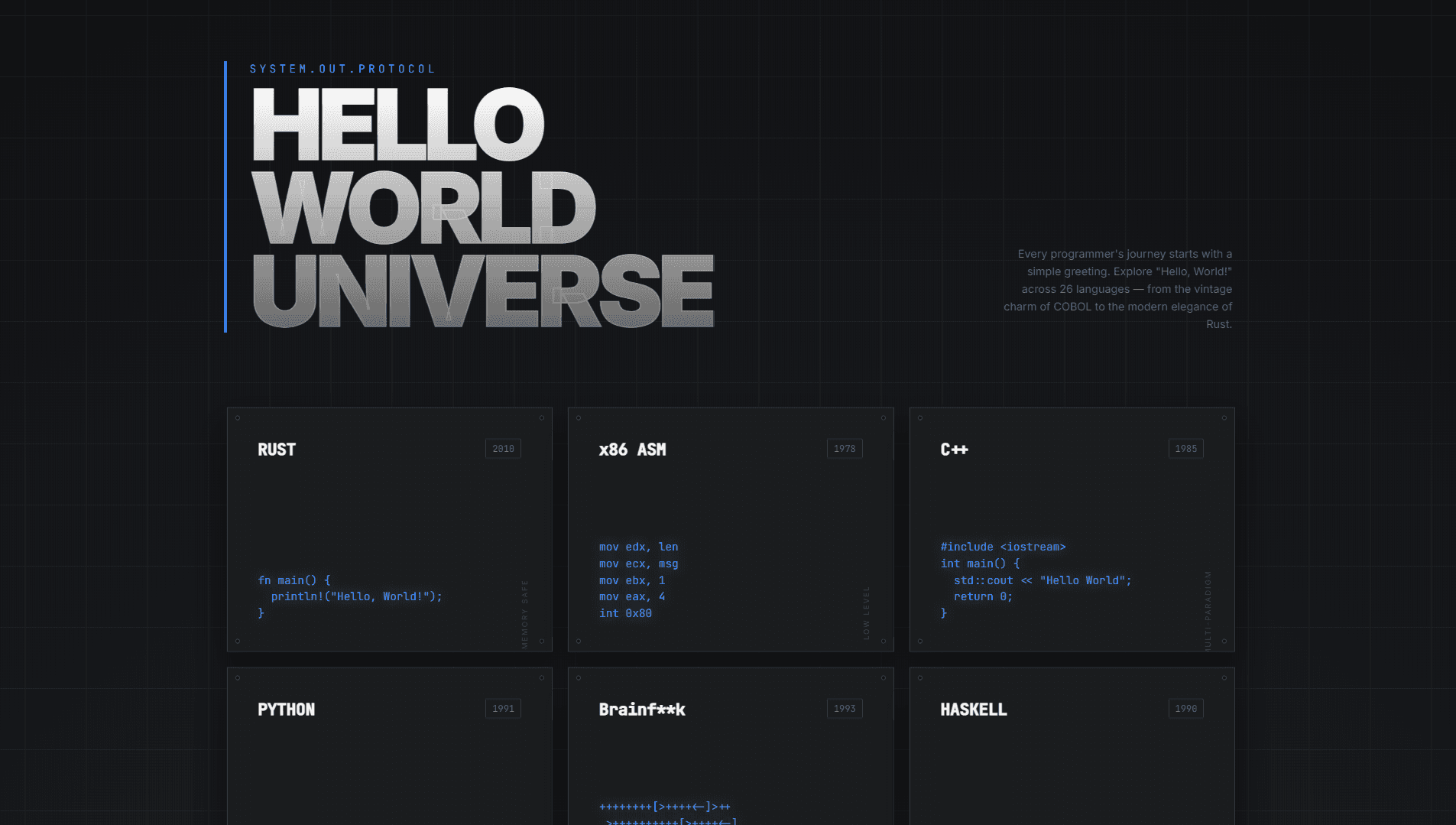
HELLO WORLD UNIVERSE
A visual and technical anthology of computational history across programming languages.
ROLE
Open Source Creator & Maintainer
STACK
Next.js / TypeScript / MDX / TailwindCSS
YEAR
2026
STATUS
[Open Source]Context & Background
A centralized, structured reference for the origin syntax, execution models, and compiler idioms of historical and contemporary programming languages.
Problem Statement
Most language syntax references are either dry text listings or fragmented across wikis. The goal was to build a curated, statically pre-rendered technical showcase where each language's snippet, execution semantics, and memory model are explored.
Zero runtime database dependencies for instantaneous edge delivery
Strict static compilation (SSG) for all language entries
High typographic precision for monospaced code blocks across desktop and mobile viewports
Architectural Blueprint
A content-driven Next.js application utilizing typed MDX documents compiled at build time into static HTML pages with zero client-side fetching waterfalls.
Content Pipeline
Structured MDX files parsed via gray-matter with custom remark/rehype syntax highlighters.
Language Registry
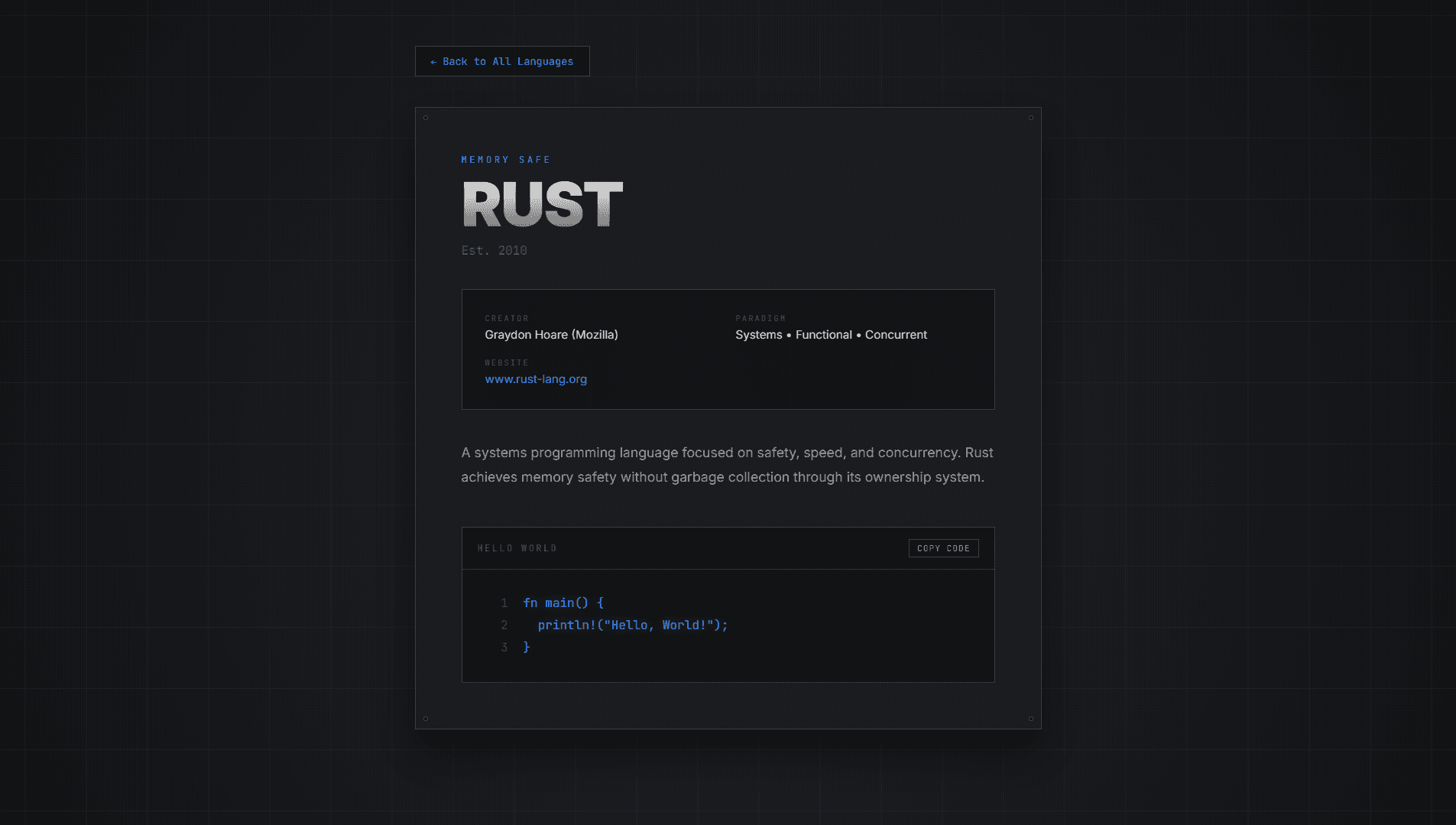
Typed TypeScript registry validating execution paradigm, author, release year, and compilation target.
Code Render Engine
Accessible code viewer with line numbering, copy mechanics, and semantic token styling.
Implementation Choices & Outcomes
MDX Static Generation instead of headless CMS
Language definitions are versioned alongside code in git, eliminating external network latency and rate limits.
Instant page transitions, offline preview capability, and simple contribution workflows.
Custom token formatting rather than heavy third-party code block embeds
Keeps client bundle size minimal while matching the custom brutalist aesthetic of the site.
Fast First Contentful Paint (FCP) and no third-party script blocking.
Architectural Tradeoffs
Pure static build vs live code execution backend
- + Infinite scaling on edge CDNs
- + Zero security attack surface for untrusted code execution
- - Users cannot run arbitrary code interactively in-browser without integrating WebAssembly runtimes
Optimization Strategies
- ⚡100% static HTML generation during build step
- ⚡Zero third-party telemetry or runtime analytics dependencies
- ⚡Sub-100ms global Time-To-First-Byte (TTFB) via edge deployment
Challenges Solved
- #Structuring syntax highlighting tokens consistently across languages spanning 60+ years (from Fortran/COBOL to modern Zig and Rust)
- #Maintaining responsive mobile layouts for long, unformatted historical assembly instructions
Retrospective & Next Iteration
Integration of WebAssembly-based micro-compilers (e.g. Pyodide, QuickJS, and Rust Wasm) would provide an optional client-side REPL for runnable languages without introducing a server backend.
Interface & Execution Records