05AI.FIELD.GUIDE/Web App
THE AI ALMANAC
A book-inspired reference to AI concepts, with a 791-term glossary, layered explanations, and personal reading tools.
- Role
- Creator & Product Engineer
- Stack
- Astro / React / TypeScript / Vite
- Year
- 2026
- Status
- Active
- Links
- Live app ↗
01Context
A living reference for AI concepts designed for both precise lookup and connected reading. The current edition organizes 791 terms in a tactile, book-inspired interface.
02Problem
AI references often separate simple explanations from technical ones and leave readers to bridge related concepts themselves. The Almanac gives each term several reading levels, related entries, and multiple navigation paths in one place.
03Constraints
- 01Generate direct, crawlable routes and metadata for glossary terms and social previews.
- 02Preserve the existing React book interface and page-turn behavior while adding static route generation.
- 03Keep reading history, bookmarks, collections, and sound preferences available without an account or server database.
- 04Keep the book readable and operable across desktop, tablet, and mobile viewports.
04Architecture
Astro owns the document shell, static routes, metadata, and generated Open Graph assets. It mounts the existing React reader as a client island. Typed term data supplies the glossary and its navigation, search, timelines, and related concepts.
- Astro app shell
- Provides the shared document layout, metadata, styles, and React island across the home, About, and term routes.
- Static route and preview generator
- Creates a clean `/term/<slug>/` page and a term-specific `/og/<slug>.svg` social image for each entry.
- React book interface
- Handles page turns, explanation modes, A–Z navigation, overlays, keyboard shortcuts, and in-app history.
- Typed glossary and search
- Stores definitions and relationships in TypeScript and supports ranked suggestions, aliases, and natural-language prompts.
- Browser reading library
- Persists reading history, bookmarks, collections, and sound preferences in localStorage.
05Decisions
D1Astro routes around the existing React reader
Why
The migration needed crawlable term pages and metadata without replacing the established book interface and its interactions.
Result
Each term has a direct static URL and social preview while the reader keeps its interactive navigation.
D2Keep the reading library in localStorage
Why
Bookmarks, history, and collections are personal reading state and do not need a user account for the current experience.
Result
Readers can save and organize terms without sign-in or a runtime database; the data remains on that browser.
D3Generate term-specific Open Graph SVGs
Why
A shared generic card would lose the context of a copied glossary link.
Result
Each term route can be shared with matching title and preview artwork.
06Trade-offs
Static Astro pages with the interactive definition body mounted in React
Gained
- +Direct term URLs and generated metadata
- +Preserves the page-turning reader and its controls
Gave up
- −Primary definition text is still client-rendered, leaving room for a later content-rendering pass in Astro
Browser-local reading state instead of cloud sync
Gained
- +No account barrier or personal reading-data backend
- +Immediate updates with no network round trip
Gave up
- −Reading history, bookmarks, and collections do not sync across devices
07Performance
- ↯Astro generates term routes and social preview assets at build time rather than fetching them from a runtime content API.
- ↯Reader history, bookmarks, collections, and sound preferences stay client-side in localStorage.
08Challenges
- #Keeping clean term URLs and browser history aligned with in-app navigation, search, keyboard shortcuts, and legacy hash links.
- #Preserving the book's proportions and legibility as its panels and navigation reflow on narrow screens.
09Learnings
- →A static route layer can improve direct access and social metadata while a client island retains a distinctive interactive reading experience.
- →A structured term model can power search, related entries, multiple explanation modes, and timeline views without duplicating the source content.
10Retrospective
A next pass could render each entry's primary definition directly in Astro while leaving the reader controls in React. That would give crawlers and readers useful term content before the interactive island hydrates.
11Gallery
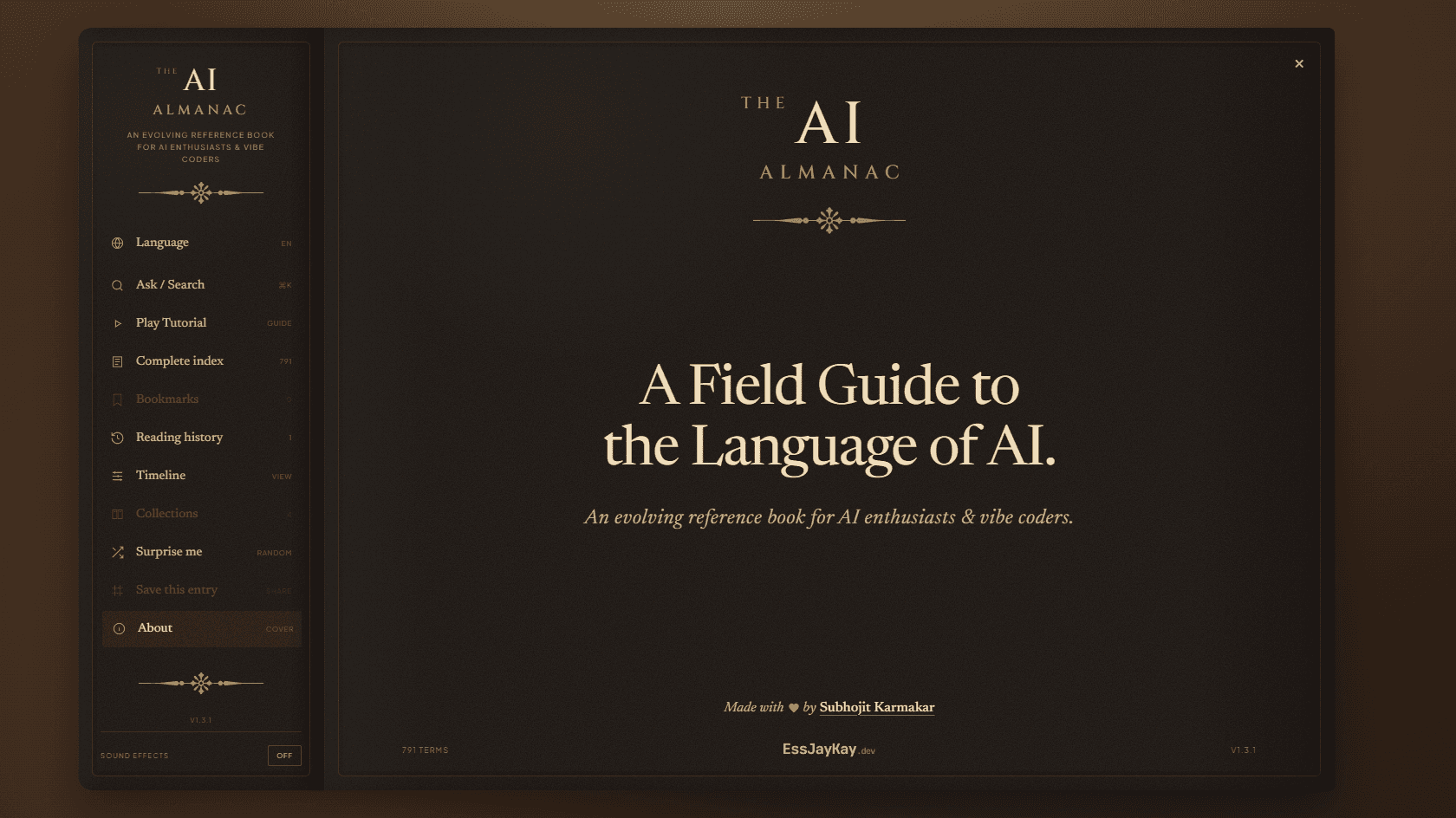
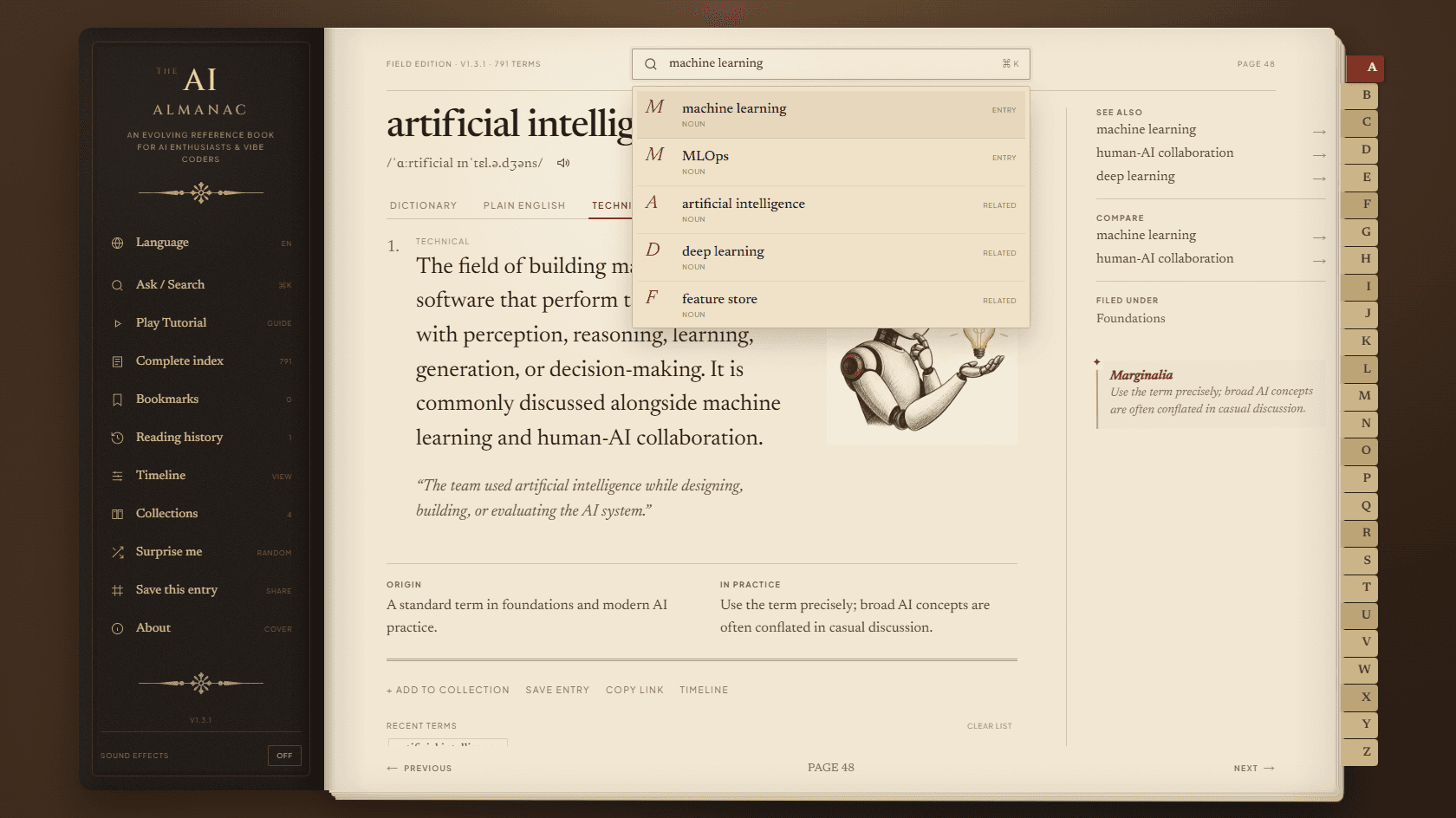
The premise. The AI Almanac makes a growing AI reference feel like a book you can browse. Its 791 terms connect through an A–Z index, related concepts, and a timeline.
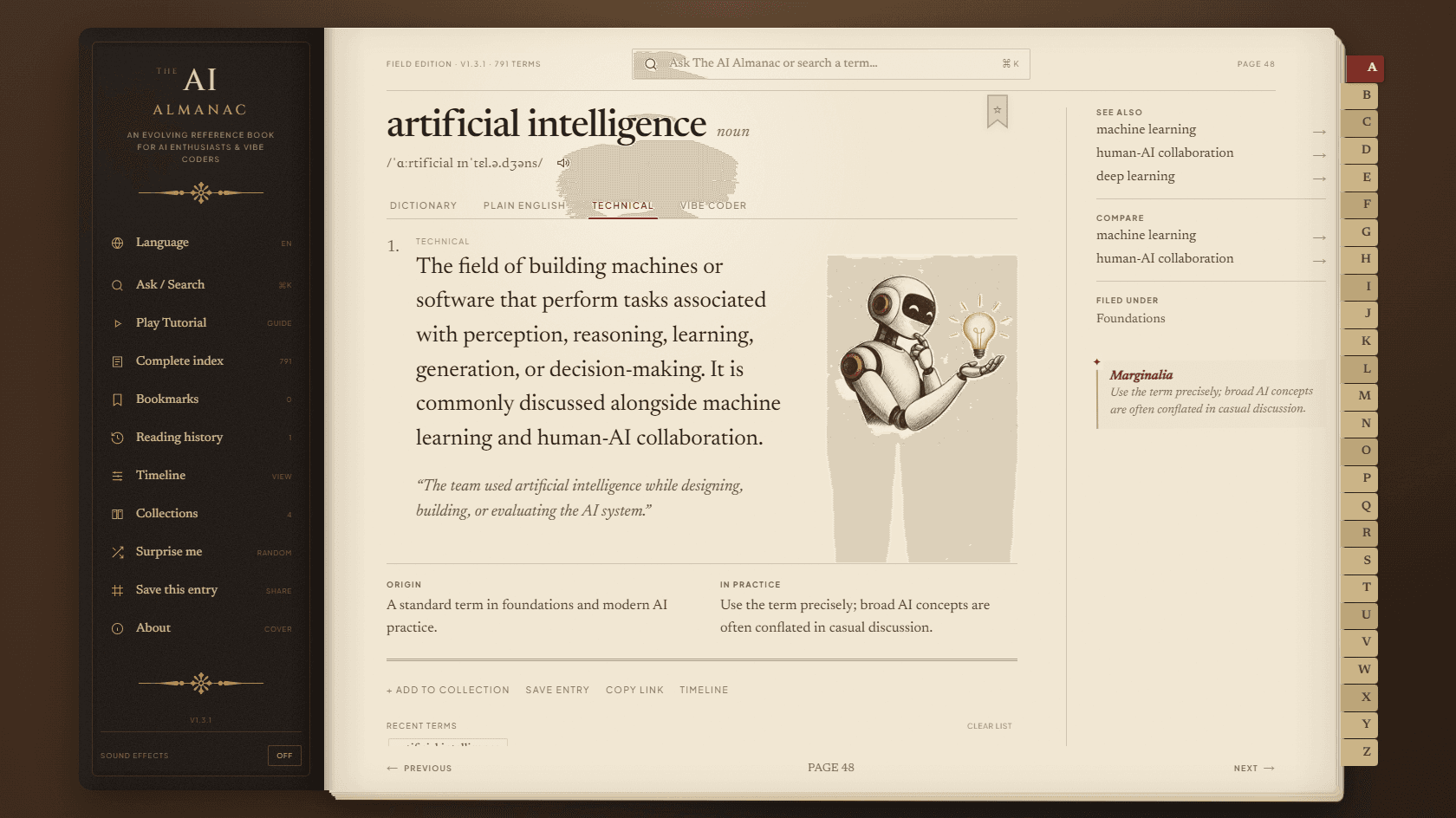
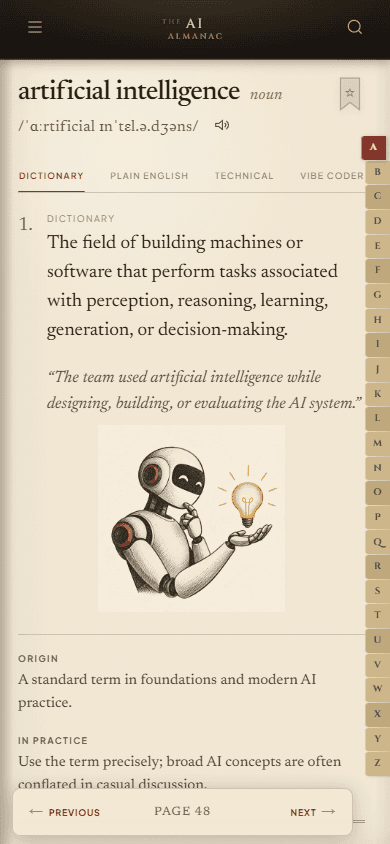
The reading. Each entry can be read in Dictionary, Plain English, Technical, or Vibe Coder mode. Ranked search, aliases, keyboard controls, deep links, and page turns support both quick lookup and open-ended exploration.
The library. Reading history, bookmarks, editable collections, and sound preferences stay in the browser. Readers can copy an entry, share a link, or save it as a PNG, with layouts for desktop and mobile.
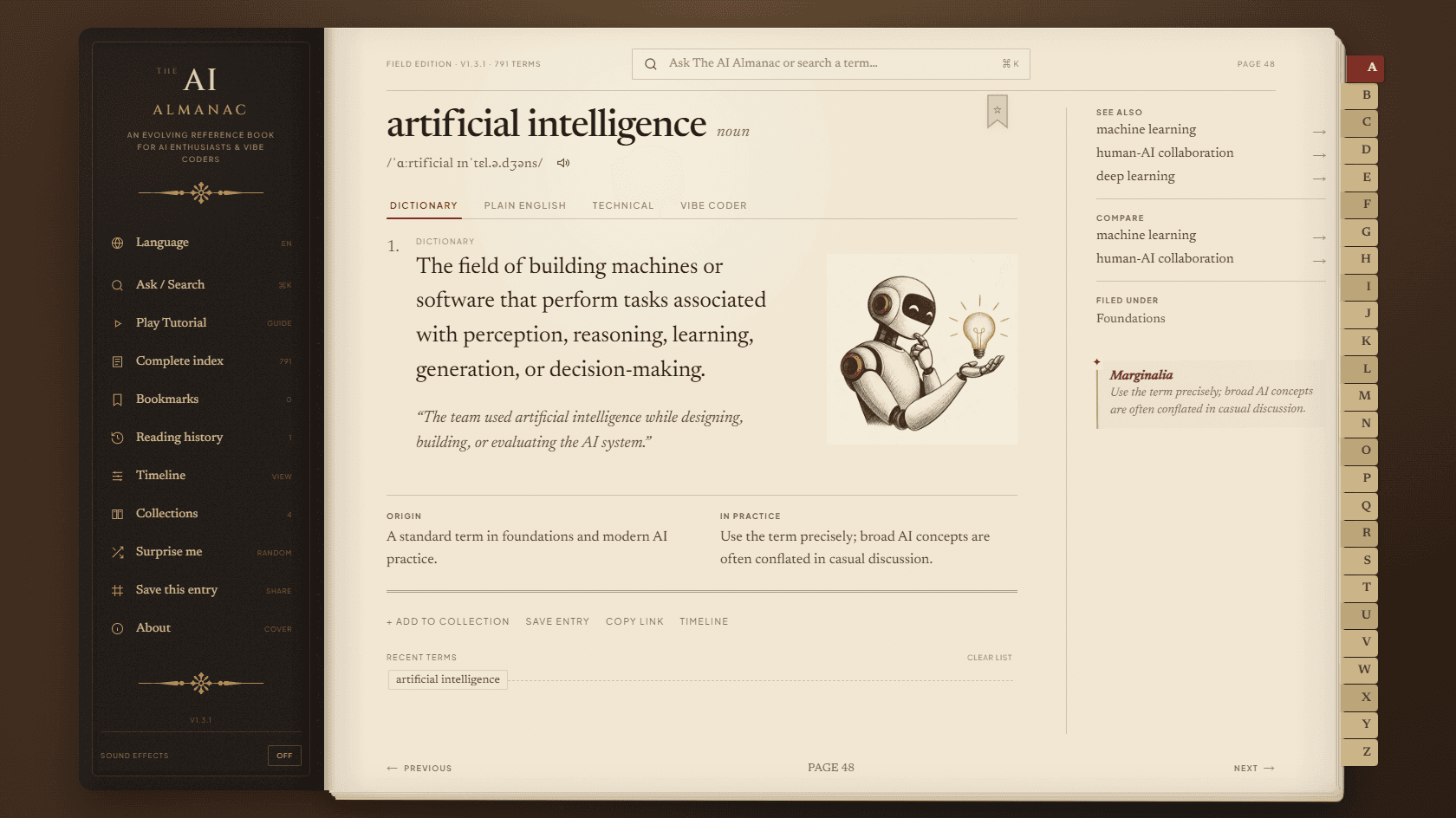
The build. Astro generates the home, About, and term routes with metadata and term-specific Open Graph artwork. A React island carries the interactive book, while TypeScript term records feed search, navigation, and related entries.
Mobile · 390×844
Next project · 01
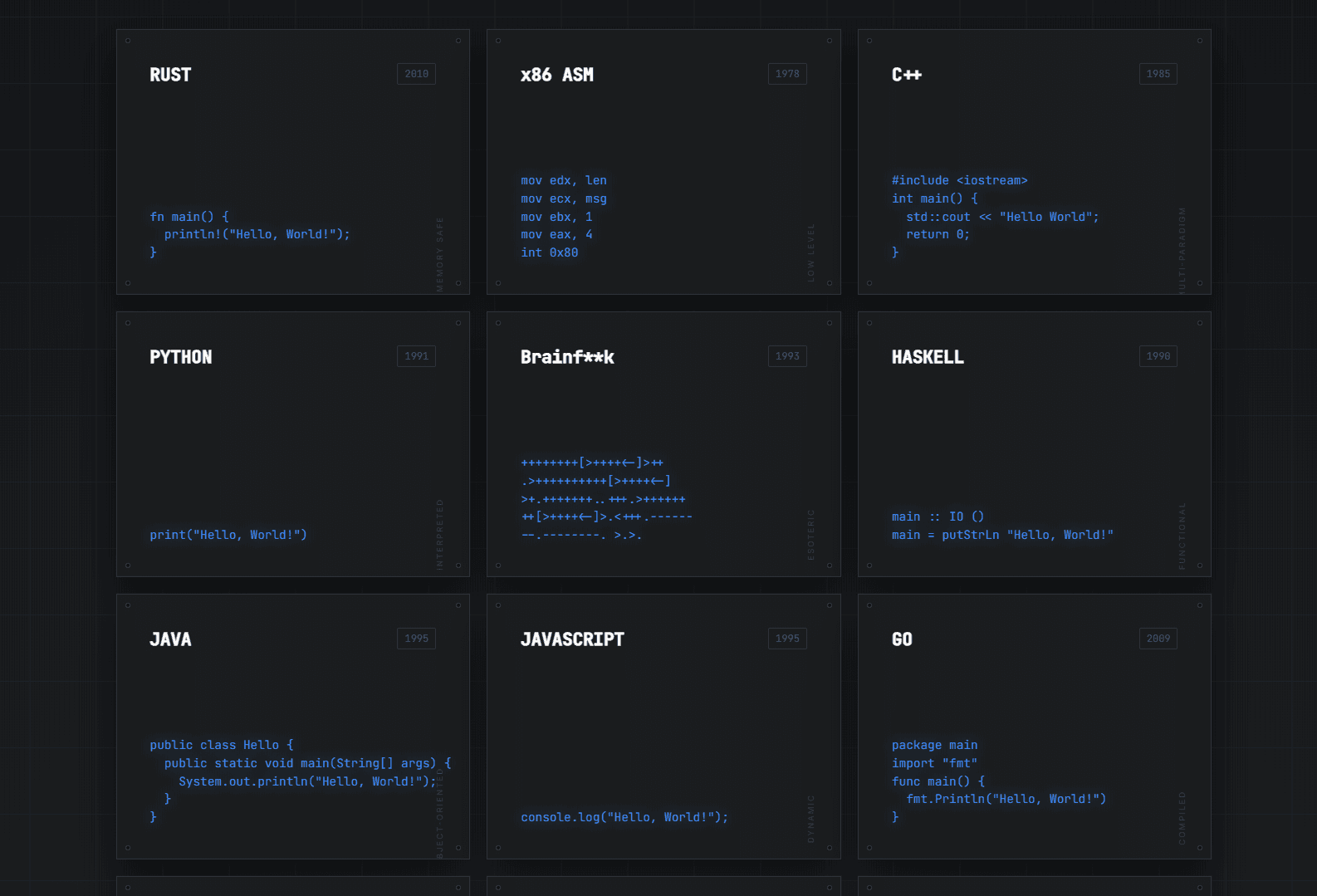
HELLO WORLD UNIVERSE →
A visual and technical anthology of computational history across programming languages.